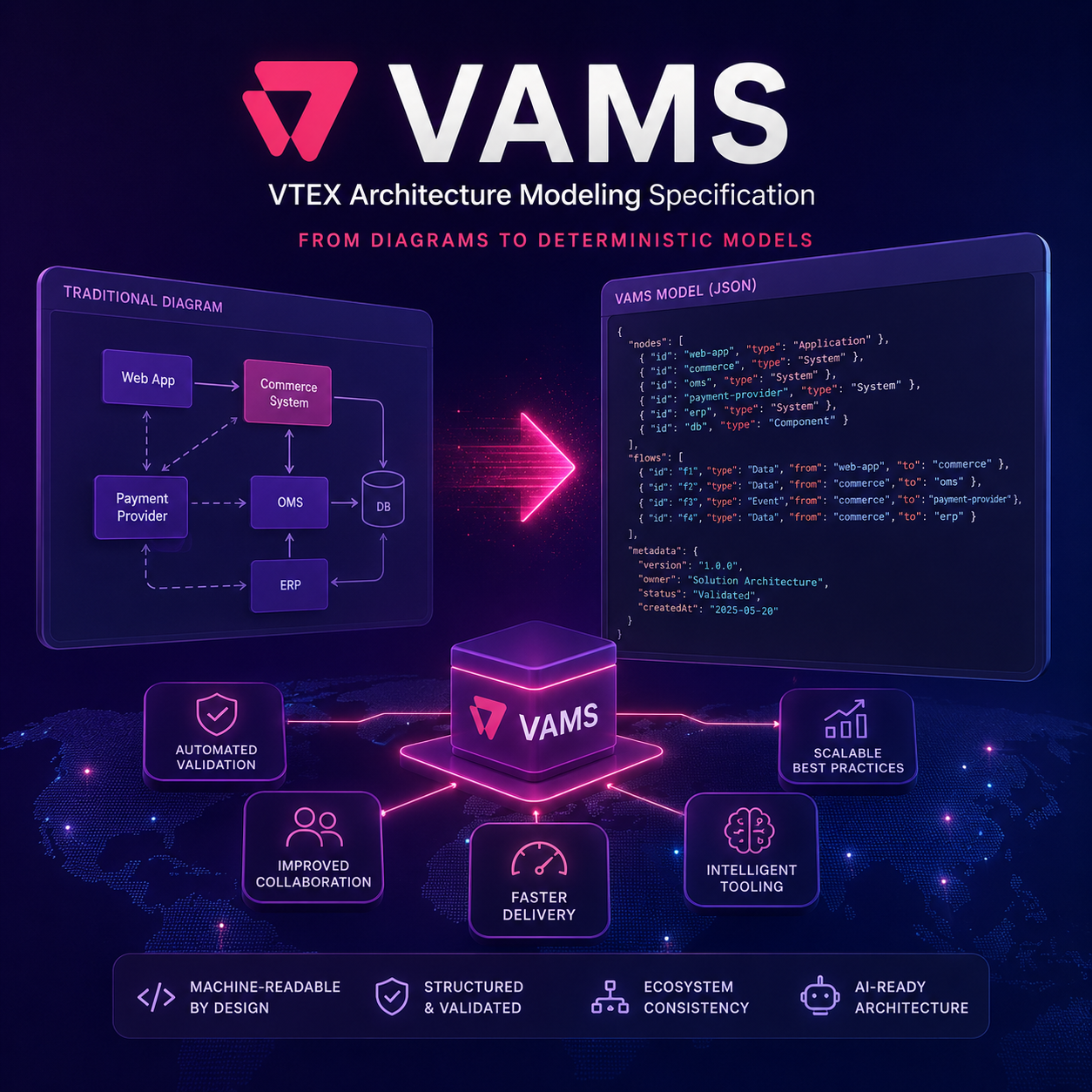
Introducing VAMS: A New Standard for Architecture Modeling at Scale
In modern commerce ecosystems, architecture is everything. It defines how systems interact, how data flows, and ultimately how reliably solutions can be delivered and scaled.
Yet, across the industry, architecture is still too often communicated through diagrams — subjective, inconsistent, and difficult to validate.
At VTEX, we set out to change that.
What is VAMS?
VAMS (VTEX Architecture Modeling Specification) is a formal, structured approach to modeling solution architectures.
Instead of relying on visual diagrams alone, VAMS introduces a machine-readable, JSON-based specification that describes architectures in a precise and deterministic way.
With VAMS, an architecture is no longer just a drawing — it becomes a validated artifact.
Why We Built It
As ecosystems grow, so does complexity. Multiple partners, integrations, and domains introduce challenges such as:
- Inconsistent architecture representations
- Ambiguity in solution design
- Difficulty validating implementations before delivery
- Limited ability to scale best practices across teams
VAMS was designed to address these challenges by providing a single, standardized modeling language for architecture.
From Diagrams to Deterministic Models
Traditional diagrams are useful for communication, but they lack structure. Two architects can describe the same system in completely different ways — and both can be "correct."
VAMS changes this by introducing:
- Structured components — clearly defined systems, applications, and modules
- Explicit relationships — how components interact through data and events
- Hierarchical modeling — consistent representation of architecture layers
- Governance metadata — versioning, ownership, and lifecycle tracking
This enables something that diagrams alone cannot: deterministic validation.
What Does This Enable?
By modeling architectures as structured data, VAMS unlocks a new set of capabilities:
1. Automated Validation
Architectures can be checked for structural correctness, consistency, and compliance before implementation begins.
2. Scalable Best Practices
Standards can be applied consistently across regions, partners, and projects.
3. Improved Collaboration
Architects, developers, and stakeholders work from a shared, unambiguous source of truth.
4. Faster Delivery
Clear, validated architectures reduce rework and accelerate implementation.
5. Intelligent Tooling
Because VAMS is machine-readable, it enables tooling that can:
- Analyze architectures
- Detect risks
- Generate implementation guidance
- Recommend improvements
A Foundation for Ecosystem Intelligence
VAMS is more than a specification — it is a foundational layer for building architecture intelligence at scale.
By turning architectures into structured, analyzable data, we can move from:
- Subjective validation → Deterministic validation
- Tribal knowledge → Codified expertise
- Isolated designs → Ecosystem-wide consistency
Use Cases Across the Commerce Landscape
VAMS is flexible enough to represent a wide range of architectures, including:
- B2C and B2B commerce implementations
- Marketplace ecosystems
- Headless commerce setups
- ERP and OMS integrations
- Event-driven microservices architectures
- Payment and checkout orchestration
The Missing Piece: Making Architecture Understandable by AI
There's a deeper shift happening in software engineering: we are no longer designing systems only for humans — we are increasingly designing them with and for AI.
Large language models and intelligent systems are becoming active participants in:
- Architecture review
- Solution design
- Code generation
- Risk detection
- Operational decision-making
Diagrams are visual, ambiguous, and lack the structure needed for deterministic reasoning. Even detailed documentation often leaves room for interpretation.
This is where VAMS becomes critical.
VAMS was designed not just to standardize architecture for humans — but to make it precisely interpretable by machines.
By expressing architecture as structured, validated data, VAMS enables AI systems to:
- Parse architectures without ambiguity
- Reason over system relationships and dependencies
- Validate designs against rules and constraints
- Generate implementation guidance grounded in structure
- Detect risks before they materialize
In other words, VAMS turns architecture into something AI can understand, analyze, and act upon.
Looking Ahead
We see VAMS as a key step toward the future of architecture:
- Human-readable and machine-understandable by design
- Continuously validated, not statically documented
- Directly connected to implementation and delivery
- Augmented by AI-driven insights and automation
As AI becomes more embedded in the software lifecycle, the way we describe systems must evolve.
Final Thoughts
Architecture should not be ambiguous. It should be clear, structured, and verifiable.
But more than that — it should be intelligible to the systems that help us build, validate, and operate it.
VAMS is a step in that direction.
By redefining architecture as structured data, we enable a future where:
- Architects design with precision
- Systems validate automatically
- AI collaborates meaningfully in the process
And architecture becomes not just documentation — but a living, intelligent artifact.