MANGOS is not the endgame. It is the beginning
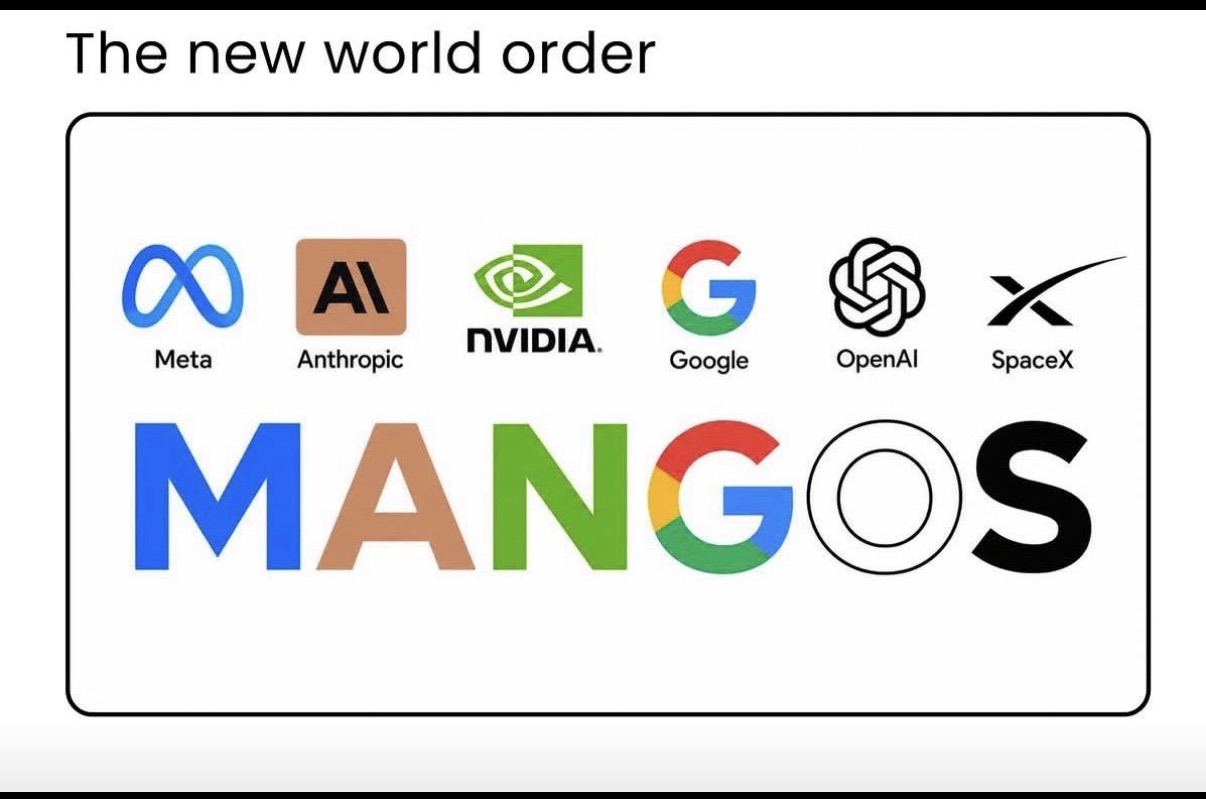
A new acronym is starting to appear in boardrooms, investor conversations and executive debates: MANGOS - Meta, Anthropic, NVIDIA, Google, OpenAI and SpaceX.
It is being used as shorthand for the new power cluster of the AI era, and perhaps as the successor to FAANG as a symbol of where technological gravity now lives.
Here is my take: MANGOS is not the destination. It is the opening move.
Over the next five years, some companies that dominate their markets today, icons of an era, businesses that once seemed structurally unassailable, may lose relevance, decline, or be replaced by new leaders. At the same time, new companies will emerge from places nobody is currently watching.
This has happened before. It will happen again. What is different this time is the speed and the depth of structural change required to survive it.
The world is being reshaped by AI. But the companies that will win are not the ones that simply add AI to what they already do. They are the ones who rebuild themselves around it entirely.
The tool-adoption trap
There is a seductive but dangerous interpretation of AI transformation that goes something like this: deploy a copilot here, add a chatbot there, automate a few workflows, report efficiency gains to the board, and move on.
That approach may create efficiency gains, but it does not create an AI-native company.
The companies building genuine competitive advantage right now are not asking, "Where can we use AI?" They are asking a harder question: "If we were starting this company today, with AI as a native capability rather than a retrofit, what would we look like?"
The answer, almost always, is dramatically different from what they look like now.
This is not a technology shift. It is a company redesign. And the gap between those two ways of thinking is where many organisations are currently losing.
What AI-native actually means
The term AI-native is used loosely, so let me be precise about what I mean by an AI-native mindset. It has concrete, structural implications that go far beyond which tools a company deploys.
The first is re-engineering the org chart to unlock AI outcomes, not to preserve legacy structures.
Most organisational hierarchies were designed for a world of information scarcity, where value came from controlling access to data, expertise and decision-making authority. AI inverts that logic. Information is becoming abundant. The constraint is now judgment, creativity and the ability to act on signals faster than competitors.
An org chart built for the old world can suppress the outcomes the new world makes possible. Redesigning for AI is not about simply cutting headcount. It is about rethinking where human judgment actually adds value, and structuring the organisation so that AI amplifies it rather than working around it.
The second is increasing talent density with genuine intentionality.
AI adoption does not happen organically at the pace this moment demands. When transformation requires a cultural shift as fundamental as this one, where every employee's relationship with their work is changing, organic adoption is too slow.
It has to be a CEO mandate, driven from the top, resourced seriously and measured against real outcomes. The companies that treat AI training as an optional benefit will be outrun by the companies that treat it as a core operating requirement.
The third, and the one I find most underappreciated, is eliminating before automating.
There is a reflexive impulse in most organisations to reach for automation as the response to inefficiency. But the highest-value process is often the one that should no longer exist.
Before you make something faster, you need to ask whether it needs to happen at all. Automating a broken process at scale just produces broken outcomes faster. The discipline of elimination, of genuinely questioning whether a workflow, a layer of approval, a reporting structure or a product feature actually needs to exist, is harder than automation, and more valuable.
The fourth is relentless commercial focus.
AI investments must drive measurable revenue growth or profitability. This sounds obvious, but in practice, it is where many transformation programs lose their way. The excitement of the technology can become its own justification. It cannot be.
Every significant AI investment should have a clear line of sight to a commercial outcome, not eventually, not in theory, but in a timeframe that the business can actually hold itself accountable to.
In commerce, this distinction is already becoming visible. The winners will not simply add AI to search, customer service, merchandising or operations. They will rethink how decisions are made across the entire business, from product discovery to fulfilment, customer experience, media and profitability.
The hidden risk for today's market leaders
If you are a market leader today, you face a specific and uncomfortable dynamic.
The capabilities that got you to dominance, your processes, your organisational structure, your institutional knowledge, your partner ecosystem, are also the things that can make transformation hardest. They are not only assets. If left unquestioned, they can become anchors.
New entrants do not have this problem in the same way. They are building AI-native from day one, without legacy infrastructure to protect or organisational politics to navigate. They will not necessarily announce themselves before they are ready. By the time many incumbents recognise the threat, the gap may already be significant.
This is not a reason to panic. It is a reason to move with urgency that many large organisations are not currently demonstrating.
MANGOS is the beginning, not the ceiling
The MANGOS companies are defining much of the infrastructure of the AI era, and their influence on how the next decade of business is conducted will be profound.
But the history of technology tells us something important: infrastructure enablers and application-layer winners are usually not the same companies.
The railroads did not own all the businesses that the railroads made possible. The internet infrastructure companies of the 1990s did not capture most of the value that the internet created. MANGOS is building the rails. The question for every enterprise leader is what they are going to build on them.
The winners of the next era will be the companies that take AI infrastructure as a given, build organisational and commercial models designed specifically for an AI-native world, and execute with relentless focus.
They will come from industries nobody is currently betting on. They will emerge from markets that look mature or even declining. They will be led by people who understood earlier than everyone else that this is not an upgrade cycle. It is a redesign.
The game is on. Execution based on experimentation driving bold outcomes is what will make the difference.