Where Retailers Actually Lose Customers
The post-checkout experience, not the moment of purchase, is what determines whether a shopper comes back. For years, e-commerce budgets have concentrated on search, cart and checkout. That is not where the relationship with a customer is actually decided anymore. Alexander Rauchut, CEO of MediaMarktSaturn Deutschland, argues that from the customer's point of view, clicking "order" is not the end of the journey but a midpoint [1].
What happens next, whether the item arrives on time, works as expected, and can be returned or repaired without friction, is what customers actually remember. A vague delivery window or a clunky returns form looks minor on its own. Together, these small frictions define whether a shopper trusts a retailer enough to come back [1].
Does Delivery and Returns Trust Really Decide Purchases?
Yes. According to survey data cited in the analysis, seven in ten consumers say they will not buy from a brand whose delivery and returns partners they do not trust, and three in ten now expect pickup and drop-off points away from their own address [1]. Both figures describe decisions shoppers make based on promises that are only fulfilled after checkout.
“Loyalty is not decided at the register. It is built in the weeks that follow the purchase.”
The data comes from a DHL e-commerce survey covering 29,000 consumers and 5,800 merchants across 29 countries [1], which gives the finding scale beyond a single market or category.
That framing matters for how commerce leaders allocate budget: acquisition and conversion get engineered in detail, while the post-checkout experience, where trust is actually won or lost, often runs on looser, less-owned processes.
What the German Market Data Shows
Germany's online retail market is growing again, but the growth is not making differentiation easier. Assortments look increasingly similar across retailers, prices are transparent to compare, and a majority of online revenue now flows through third-party marketplaces rather than direct storefronts [1].
When the front end looks the same everywhere and marketplaces control most of the transaction volume, the parts of the experience a retailer still fully controls, delivery, returns and service, become the actual competitive lever [1].
| Metric (Germany, 2025) | Value | Source |
|---|---|---|
| Online share of total retail | 13.5% | [1] |
| Online sales via marketplaces | Majority share | [1] |
Why Physical Stores Are Becoming Fulfillment Hubs
A store's value can no longer be measured only by revenue per square meter. That metric stays relevant, but it misses most of what a physical location now does inside a digital-first business [1].
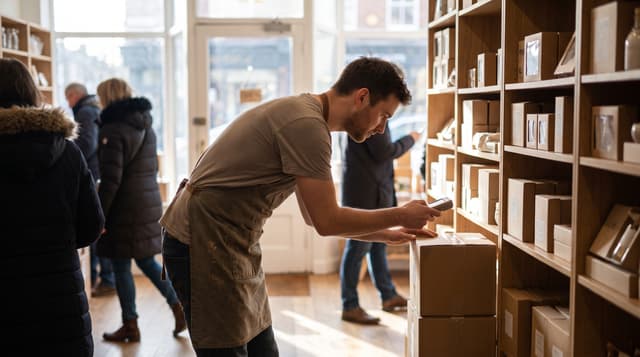
A single location can double as an advisory point, a pickup and return station, a source of local inventory, a repair intake counter, a showroom, and a launch point for same-day delivery [1]. That turns the store into an operational extension of the online business rather than a separate channel competing with it.
The wallet-share data backs this up outside Germany, too. McKinsey's 2026 grocery research found that shoppers using multiple channels with a retailer allocate 31% of their category spend to that retailer, compared with 26% for shoppers who buy only in-store [3], a gap that reflects how fulfillment flexibility keeps customers coming back to the same brand across channels.
How Commerce Teams Are Re-Architecting the Post-Checkout Experience
Returns are not a marginal cost line. U.S. retailers took in $743 billion in returns last year, according to National Retail Federation and Appriss Retail transaction data [2], and how a retailer handles that volume shapes whether a customer buys again.
Channel matters here: the return rate for in-store purchases runs at roughly a third of the rate for online purchases [2], which is one reason retailers are pushing pickup, in-store returns and local inventory visibility harder into their online experience rather than treating stores and web as separate systems.
Making that work operationally requires an order management layer that treats warehouse stock, store inventory and marketplace listings as one pool, rather than three disconnected ones. Commerce platforms, including VTEX's order management and marketplace capabilities, are increasingly built around that principle.
A single order can be sourced from the nearest store, tracked through one interface regardless of carrier, and returned at a different location than where it was bought, without the shopper noticing the handoffs between systems underneath.
What This Means for Commerce Leaders
Rauchut's argument points to five operating priorities for retailers rebuilding around the post-checkout journey [1]:
The next competitive edge in e-commerce will not come from a better checkout flow or a faster payment step. It will come from what happens once the order is placed, and whether a retailer's systems can keep the promise made at the point of sale [1].
- 1Put customer satisfaction into strategic planning, not just marketing metrics, since it is earned wherever a promise has to be kept.
- 2Give pure online retailers the same service rigor as omnichannel ones. Not having stores is not an excuse for weaker post-purchase support.
- 3Make shop, store, logistics and service function as one system from the customer's side, not separate departments with separate rules.
- 4Match service investment to the category. Complex, advice-heavy products justify more service; low-cost, simple products can be overserved into unnecessary cost.
- 5Watch the handoffs closely. Most failures happen exactly where responsibility passes from one team or partner to another [1].
Sources
- [1]etailment, Omnichannel: Warum Kundenzufriedenheit nicht mit dem Checkout endet — etailment.de
- [2]Retail Dive, Return policies sway customer behavior: survey — retaildive.com
- [3]McKinsey & Company, The State of Grocery North America 2026 — mckinsey.com