What is quick commerce, and why is Brazil entering a new phase of it now?
Quick commerce is the delivery of everyday goods, groceries, pharmacy items, convenience products, in under an hour, often in 10 to 30 minutes, by positioning inventory close to the customer rather than relying on a traditional warehouse-to-door chain.
The model surged globally during the pandemic, cooled in Europe and the US as unit economics proved difficult, and is now reappearing in a different form. Brazil is in the middle of that second wave, driven not by standalone dark-store startups but by platforms with existing scale.
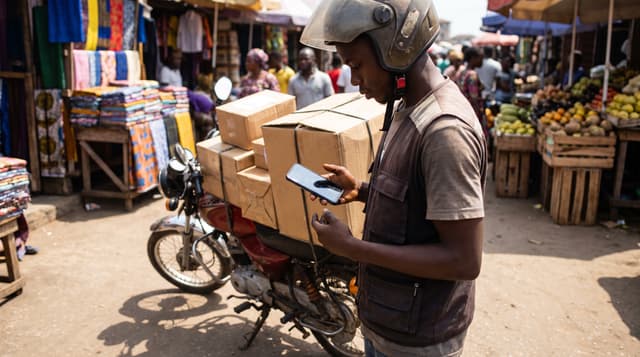
In August 2025, iFood launched Turbo in São Paulo with delivery promised from 10 minutes for restaurants, pharmacies and pet shops [1]. Amazon followed in 2026 with Amazon Now, promising 15-minute delivery for a curated set of immediate-need items [1]. Both moves sit on top of a digital commerce base that was already large: Brazil's online economy generated R$235.5 billion in sales in 2025 [1].
How is iFood scaling ultra-fast delivery across the country?
iFood's Turbo rollout answers this with speed and data density rather than new physical infrastructure alone. Less than a year after its São Paulo launch, Turbo was live in 130 cities with delivery windows of up to 20 minutes, and the company says most of its overall orders arrive within 30 minutes [1].
The operation runs on roughly 30 AI models per order, combining distance, traffic conditions, preparation time, courier availability and routing to hit those windows [1]. That matters because Turbo isn't built from scratch: it draws on an ecosystem that processed 180 million orders in November 2025 alone, a figure that spans far more than quick commerce but illustrates the scale the new service inherits [1].
The adoption signal is the more telling number. iFood reports that over 40% of consumers choose the ultra-fast option whenever it's offered [1]. That's a demand signal, not just a capacity one: customers aren't simply tolerating faster delivery, they're actively selecting it when the choice exists, which raises the bar for every competing format in the same category.
What does Amazon's entry change about the competitive map?
Amazon Now's arrival matters because it imports a different playbook into Brazil: compressing the distance between stock and shopper rather than scaling a network of delivery partners. The service promises delivery in as little as 15 minutes on a curated assortment built for immediate needs [1]. It extends a strategy Amazon has run elsewhere, where owning inventory placement, rather than coordinating independent merchants, is the core lever for speed.
That's structurally different from the iFood model, which plugs into existing partner stores and restaurants to add delivery on top. iFood organizes a network it doesn't own; Amazon Now positions stock it does. Both are racing toward the same customer promise from opposite ends of the supply chain, and Brazil is now the market testing which approach, or which hybrid of the two, holds up at scale.
Why is the store becoming part of the warehouse, too?
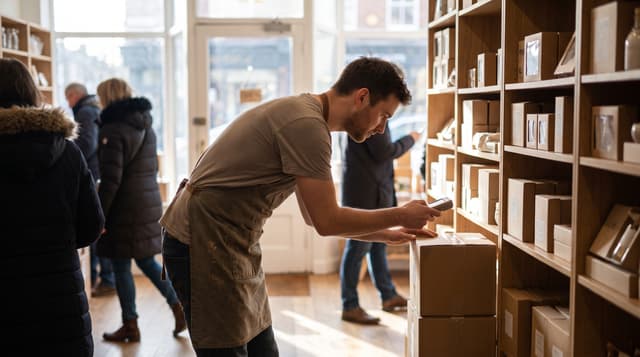
For decades, a retail store's inventory was built to serve whoever walked through the door. Quick commerce changes that function: the same stock now needs to serve the person browsing the aisle and the person ordering from three kilometers away on a phone.
In Brazil, this shows up as ship-from-store, where retailers use physical locations as de facto micro-fulfillment points, alongside iFood's reliance on partner establishments as origin points for delivery, and expanding logistics platforms layering distribution networks on top of both [1].
This dual purpose is an operational problem before it's a strategic one. A single stock-keeping unit now has two live demand channels pulling against it in real time, and the systems recording availability, allocating orders and sequencing picks have to reconcile both without either channel overselling against the other.
Retailers that treat ship-from-store as a bolt-on reporting feature, rather than as a core inventory and order-orchestration capability, tend to discover the gap at the worst possible moment: during a stockout a shopper only finds out about after checkout.
How does Brazil's build-out compare with other markets racing on speed?
Walmart's US operation illustrates the owned-infrastructure end of that spectrum: it offers delivery in as fast as 30 minutes across 33 US markets, covering more than 100,000 eligible items spanning fresh food, pharmacy, baby products, pet supplies, electronics and household goods [1].
Amazon's global same-day and next-day Prime network delivered more than 13 billion items in 2025, with US volume alone up more than 30% year over year [1]. Brazil doesn't yet have a single operator at that scale; it has several partial versions of each architecture running at once.
| Market | Core architecture | What it depends on |
|---|---|---|
| China (Meituan, Alibaba, JD.com) | Platform organizes delivery for existing merchant stores | Dense merchant network, light owned-infrastructure footprint [1] |
| United States (Amazon, Walmart) | Owned stock, stores and distribution centers combined | Capital-intensive fulfillment and forecasting infrastructure [1] |
| Brazil (iFood, Amazon Now, retailers) | Hybrid: partner stores, ship-from-store, new dark-leaning stock positions | Whichever combination of the above a given retailer can fund and operate [1] |
Does delivery speed alone make quick commerce profitable?
No. Two cautionary cases, one in France and one in the UK, show that a fast promise doesn't automatically clear a viable cost structure. Paris saw more than 80 dark stores open during the pandemic-era boom, 60 of them within city limits, before zoning rules restricting warehouse space in residential buildings and limiting storage to a third of a commercial unit's footprint effectively ended new dark-store openings there [1].
The UK offers the opposite failure mode: not regulation, but margin. Amazon announced the closure of its remaining 19 Amazon Fresh stores in 2025, after closing its first UK store in 2023, shifting its grocery focus to e-commerce and retail partnerships instead [1]. Industry sources told Reuters that UK grocery margins below 5% make it difficult to sustain dedicated physical infrastructure without sufficient scale [1].
The pattern underneath both cases is the same: the shorter the promised delivery window, the more an operation depends on order density, nearby stock and efficient picking to avoid turning every low-ticket order into a loss. Brazil's test is whether its urban density and existing delivery infrastructure let it clear that bar where Paris and London couldn't.
What should commerce and IT leaders take from Brazil's race for minutes?
The practical lesson for any retailer or CPG brand watching this build-out isn't "ship faster." It's that speed is now a function of inventory architecture, not courier logistics alone. A few capabilities separate the operators who can compete on minutes from those who can only watch:
Brazil's digital commerce base, R$235.5 billion in 2025 and projected to keep growing through the decade [1][3], gives operators room to experiment. Whether that experimentation turns into a durable model depends less on how many minutes a company promises and more on whether its inventory and order systems can honor that promise profitably, order after order.
- Real-time, unified stock visibility across stores, dark-store nodes and distribution centers, so the same unit isn't promised twice to two channels at once.
- Order orchestration that can route a single order to whichever fulfillment point is fastest and most cost-efficient at that moment, not a fixed default.
- Clean, structured product and location data, since routing algorithms like the ones iFood runs per order are only as reliable as the data describing distance, stock and preparation time feeding them [1].
- A clear-eyed cost model for the "last 100 meters," built before expansion, not after, given how thin margins get as promised windows shrink [1].
Sources
- [1]Mercado&Consumo, Quick commerce: o Brasil na corrida dos minutos — mercadoeconsumo.com.br
- [2]EMARKETER, FAQ on last-mile delivery: How the final step of fulfillment will take shape in 2026 — emarketer.com
- [3]EMARKETER, Latin America reclaims its spot as the world's fastest-growing ecommerce market — emarketer.com