Convenience points have outgrown their role as a shipping fallback
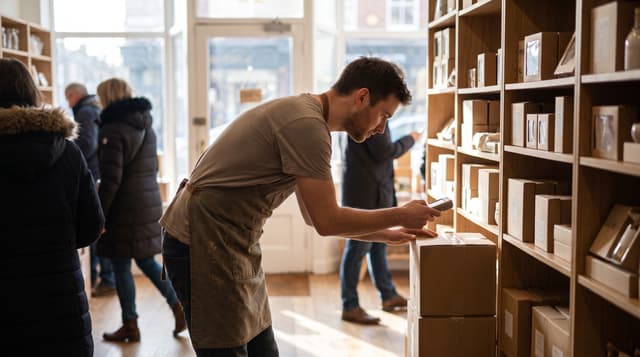
Convenience points, also called pickup-and-drop-off locations, started as a workaround for missed home deliveries. Carriers across Spain and Portugal now describe them as a deliberate fulfillment lever, not a stopgap: a way to cut failed-delivery costs, stabilize operations during demand peaks, and keep the promise made at checkout. [1]
The clearest evidence comes from NACEX, one of the carriers reshaping its network around these points. Its NACEX.shop network managed double the 2025 parcel volume it handled the year before, and convenience points now account for 13% of its total e-commerce shipments across Spain and Portugal. [1] That is not a marginal channel; it is a load-bearing part of how the carrier absorbs peak-season volume without letting service levels slip.
One carrier's network doubled in a single year
The network now spans more than 4,000 locations across Spain and Portugal, and the table below sets out NACEX's 2025 figures. [1]
The growth did not come from scattering random drop-off spots. NACEX built the network around strategic locations and extended opening hours, the two features carriers say matter most to shoppers who no longer want to wait at home for a delivery window. [1]
| Metric | 2025 figure |
|---|---|
| Share of NACEX's e-commerce shipments | 13% [1] |
| Network size (Spain + Portugal) | 4,000+ points [1] |
| Year-over-year shipment growth | Doubled [1] |
Why home delivery alone cannot solve last-mile friction
Home delivery still fails often enough to be expensive: missed attempts, restricted building access, and narrow delivery windows all push costs up and satisfaction down. Convenience points fix this by widening the pickup window to most of the day, seven days a week, at a location the shopper already passes. [1]
The specific frictions convenience points are built to absorb include:
- Failed first-attempt deliveries, which force a costly redelivery or a trip to a depot.
- Restricted access to apartment buildings and gated offices during standard delivery hours.
- Fixed, narrow delivery windows that rarely match a shopper's actual schedule.
- Returns handled only through a single depot, far from where the shopper lives.
Click-and-collect's trajectory: from pandemic patch to a multi-billion-dollar channel
In the US, pickup-based fulfillment followed the same arc at a larger scale: a pandemic-era patch that hardened into permanent infrastructure, and the channel kept growing every year after, even as the growth rate cooled. [2]
The 2021 slowdown came as the initial pandemic surge faded, yet EMARKETER's forecast, published in March 2023, still expected double-digit growth through 2026 even as adoption matures. [3] Separately, EMARKETER projected in December 2022 that 150.9 million people in the US, 53.1% of the population, would use click-and-collect by 2024. [4]
| Year | US click-and-collect sales | Context |
|---|---|---|
| 2020 | $70 billion [2] | ~10% of e-commerce sales [2] |
| 2021 | $80.28 billion [3] | Growth slowed to 9.7% [3] |
| 2026 (forecast) | $131.66 billion [3] | Still double-digit annual growth [3] |
What should commerce leaders change for 2027 planning?
Treat pickup networks as a planned channel with its own targets, not an overflow valve for failed deliveries. That means choosing carrier partners by point density and opening hours, not price alone, and building checkout logic that surfaces pickup options where they genuinely save the shopper time. [1]
There is a cost argument behind this, not just a convenience one. Fewer failed delivery attempts and consolidated routes mean fewer kilometers driven per parcel, a secondary benefit worth tracking against sustainability targets as pickup volume scales. [1]
Turning a pickup network into a loyalty and cross-sell channel
A convenience point is also a checkout touchpoint retailers can use beyond the handoff itself: a chance to confirm the next purchase, extend a loyalty incentive, or resolve a return on the spot. Retailers that treat pickup as a relationship moment, not a logistics footnote, get more out of the same parcel. [1]
That reframing is already visible in how carriers talk about the channel. Handling both delivery and returns at the same point simplifies the experience for the shopper and reduces the administrative cost of processing a return through a separate channel. [1] The operators building out these networks expect convenience points to keep gaining ground as a standard part of fulfillment strategy in the years ahead. [1]
Sources
- [1]Ecommerce News, Los puntos de conveniencia: de alternativa de entrega a herramienta estratégica para el eCommerce — ecommerce-news.es
- [2]Retail Dive, 4 ways to improve the BOPIS experience for maximum retention — retaildive.com
- [3]EMARKETER, Click-and-collect Trends & Statistics — emarketer.com
- [4]EMARKETER, Click-and-collect Trends & Statistics — emarketer.com