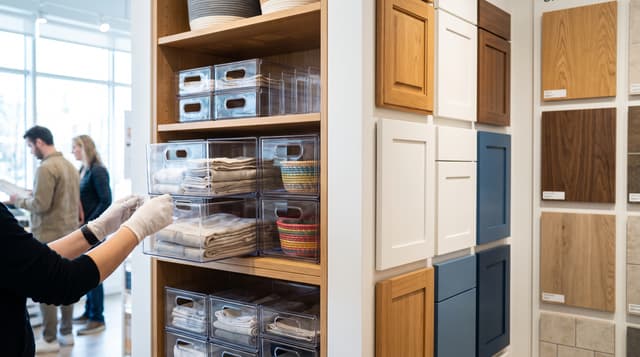
Store shelves have become Walmart's fulfillment centers
Walmart's Q3 results show that its stores, not dedicated warehouses, are doing the heavy lifting behind its online growth. More than 80% of U.S. e-commerce orders, inclusive of the retailer's online marketplace orders, are fulfilled from stores, executives noted on the call [1][2].
That shift paid off. The quarter beat Wall Street's expectations and pushed Walmart to raise its full-year outlook for the third time this year [1].
| Q3 metric | Growth | Source |
|---|---|---|
| Walmart U.S. e-commerce | 23% | [3] |
| Sam's Club U.S. e-commerce | 30% | [3] |
| Global e-commerce | 17% | [3] |
| Total company revenue | 5.2% to $188.8B | [1] |
| Store-fulfilled deliveries | 40%+ | [2] |
What's driving new customers to Walmart's checkout isn't price alone
Fulfillment speed is now a stated competitive advantage: Walmart can reach 96% of U.S. households with a delivery window of three hours or less, Walmart U.S. President and CEO Dave Guggina said on the earnings call [1]. That reach is what Walmart is leaning on heading into the holiday quarter, when delivery promises decide whether a shopper checks out or abandons the cart.
“So if we pick faster, we can either reach further and get to more customers in 30 minutes or we can deliver more quickly to our customers.”
The fastest-growing tier is even more aggressive. Deliveries made in under 30 minutes almost tripled in Q3, and Walmart's 30-minutes-or-less service, expanded into 38 U.S. markets as of August, now reaches 60% of U.S. households, including roughly 15 minutes of in-store picking time [2]. Guggina framed picking speed as the lever that determines everything else:
CFO John David Rainey connected that speed directly to conversion. He told CNBC that growth in online orders for Walmart and Sam's Club was driven by an emphasis on faster delivery and lower prices [3], and on the earnings call he was more specific: faster delivery speeds are leading to higher customer and member conversion [2].
How is fast delivery finally starting to pay for itself?
Running a three-hour, or thirty-minute, delivery network is expensive, but Walmart executives say the math is finally improving. The company's e-commerce business is now "pretty close to break-even" once advertising revenue is excluded, Rainey told analysts, a notable shift for a channel that has historically lost money at scale [1].
Three structural choices explain why the unit economics are moving in Walmart's favor:
CEO John Furner added that the marketplace piece also lets stores support a larger marketplace business [2]. Expedited deliveries, the costliest to run, still climbed more than 50% in the quarter, meaning Walmart is absorbing that cost rather than passing all of it to the shopper [2].
- Using stores as last-mile nodes instead of building out a parallel warehouse network, cutting incremental delivery cost per order.
- Opening "Walmart Depot" delivery stations that hold forward-deployed inventory, letting drivers run denser routes and lower the cost per package [2].
- Routing select third-party marketplace inventory into stores so it ships alongside first-party orders on the same local delivery run [2].
Why fulfillment speed is now a boardroom metric, not just an operations one
Fulfillment speed shows up on Walmart's earnings call because it now moves the topline, not just the cost line. Wall Street analysts are reading the quarter the same way: Walmart is gaining share and leaning into value while higher-margin businesses like advertising and membership scale around that base of e-commerce growth, Jefferies analysts wrote in a note the day results came out [1].
GlobalData Managing Director Neil Saunders put the dynamic in sharper terms, noting that e-commerce "is the main arena in which Walmart is winning new customers, especially higher-income ones," even if it means absorbing more investment in the store network that supports it [1].
Walmart's combined Walmart+ and Sam's Club Plus membership, launched in October, adds a different angle. Sam's Club has already added "a couple million new members" since the bundle debuted, Furner said, tying membership growth to the same fast-fulfillment promise that is pulling in e-commerce orders [1].
What enterprise commerce teams should take from this quarter
Walmart's Q3 is a reminder that fulfillment promise and checkout conversion are now the same conversation, not two separate ones. A retailer's ability to quote, and keep, a fast delivery window depends on real-time inventory visibility across stores, dark stores and distribution centers feeding one order management layer, the same composable infrastructure problem mid-market and enterprise retailers are solving at smaller scale.
The specific tactics Walmart used, turning store inventory into sellable, shippable supply and layering forward-deployed micro-fulfillment nodes on top of it, are available to any retailer with unified inventory data and an order orchestration layer flexible enough to route each order to its cheapest, fastest fulfillment point. Walmart's scale is unique; the underlying architecture decision, treating every location as a potential fulfillment node, is not.
Sources
- [1]Retail Dive, Walmart's e-commerce boom driven by fulfillment speed — retaildive.com
- [2]Supply Chain Dive, Walmart's sub-30-minute delivery volume surges in Q3 — supplychaindive.com
- [3]CNBC, Walmart (WMT) Q3 2026 earnings — cnbc.com