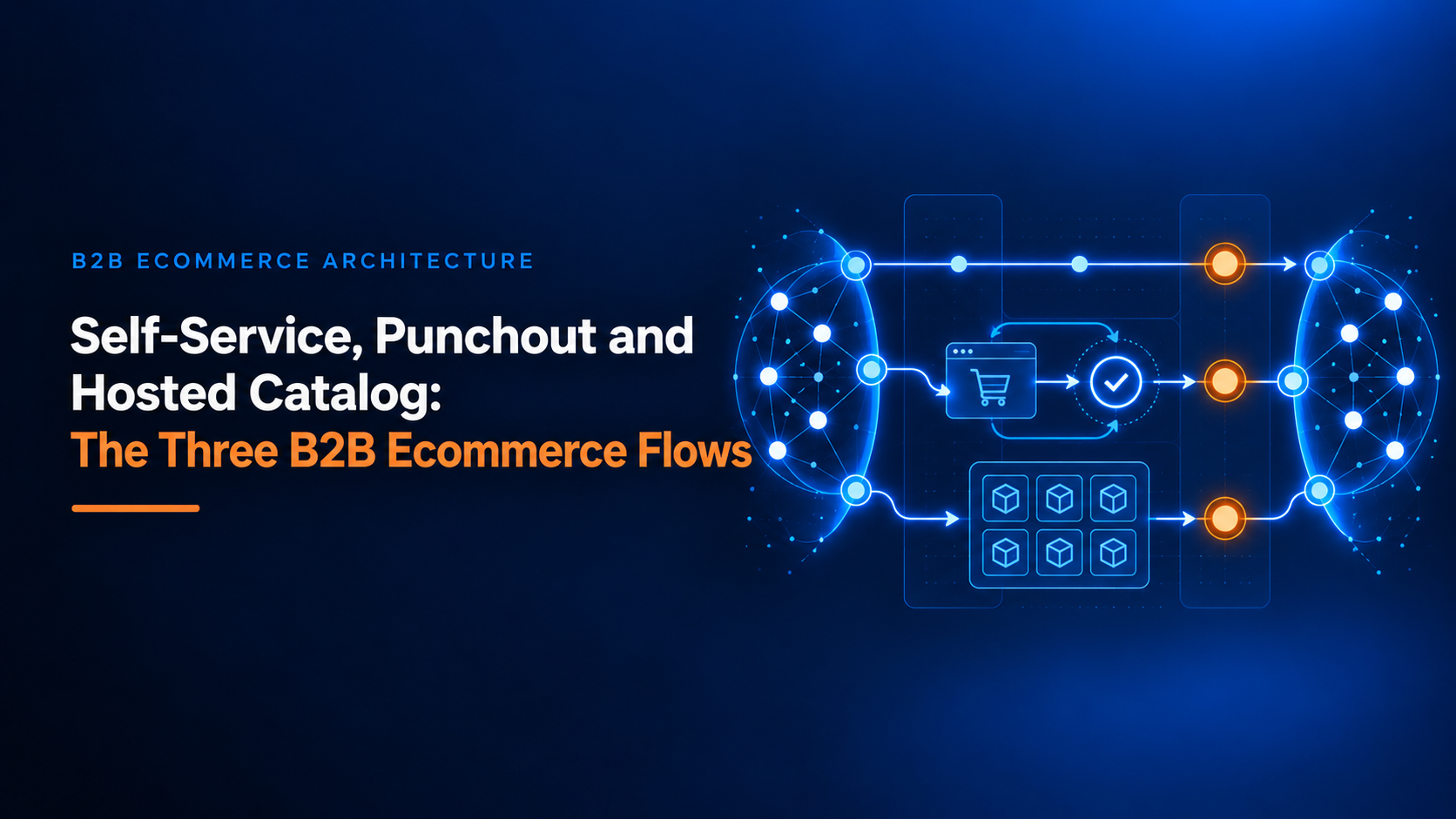
B2B ecommerce is usually talked about as a single channel. In practice we are dealing with three, and the difference between them is not technical. It comes down to who controls the shopping experience, where the cart is created and where the order is created.
We call them self-service, punchout and hosted catalog. With self-service, the buyer shops on the ecommerce website and orders there. With punchout, the buyer starts in their procurement system, builds the cart on the ecommerce website and sends it back for approval. With hosted catalog, the buyer never leaves their procurement system, because the supplier's catalog already lives there.
The supplier rarely gets to choose. Each buyer arrives with the flow its procurement team has already standardized on, and company size weighs heavily on that choice. Larger buyers tend to run formal procurement systems and require orders to go through them, while smaller ones often have no such system and are happy to order on the supplier's site. That choice shapes how every order gets built.
So the useful question is not which flow is best. It is how the same order gets built in each of them, and what changes for the buyer and the supplier when it does.
Self-service
Self-service is the flow most of us picture first. The buyer logs in to the ecommerce website with a company account, browses, builds a cart and places the order there. The experience, the cart and the order all live on the supplier's side, which makes it the only one of the three flows where the supplier controls the whole journey.
What to keep in mind
- It needs a B2B-ready ecommerce platform. Company accounts, roles and permissions, and contract pricing and assortments resolved per buyer.
- Approvals, budgets and authorization flows have to live somewhere. When there is no procurement system on the buyer's side, the ecommerce platform carries that logic, configured per buyer if they want it.
- The buyer has to adopt the supplier's portal. Every extra login is friction, especially for larger buyers whose purchasing already runs through a procurement system.
Benefits
- Full control of the experience. Search, merchandising, cross-sell and branding stay entirely with the supplier.
- Real-time price and stock by default. No copy of the data sits in another system waiting to go stale.
- The lowest effort per additional buyer. No per-buyer procurement integration, onboarding is mostly creating the account.
- First-party shopping data. The supplier sees how the buyer searches, browses and builds the cart, not just the final order.
Self-service gives the supplier the most control, and asks the most of the buyer.
Punchout
With punchout, the journey starts somewhere else. The buyer opens their procurement system (Ariba, Coupa or Jaggaer, for example), selects a supplier and is passed to the supplier's ecommerce site already authenticated. They shop there, build the cart and send it back to the procurement system as a requisition. Approval happens on the buyer's side, and only then does a purchase order exist and travel to the supplier.
That split is what defines the flow. The cart is created in the supplier's environment, but the order is created in the buyer's.
What to keep in mind
- Each procurement system needs its own integration. Authentication, cart return and buyer identity are set up separately for every system, and each new buyer means onboarding and testing.
- Product data has to meet the procurement system's requirements. Units of measure, identifiers and classification codes need to match what the buyer's system expects, or the requisition comes back wrong.
- The order arrives later and asynchronously. The purchase order is created after approval, outside the shopping session, so what was valid in the cart has to hold when the order lands.
- Approvals and budgets are the buyer's. They run in the procurement system, so the supplier does not replicate them.
Benefits
- The shopping experience stays with the supplier. Search, product browsing and add to cart happen outside the procurement system, which greatly improves the buyer's experience.
- Real-time price and stock. Contract pricing and availability come from the live site, not from a copy.
- Governance stays with the buyer. Approvals, budgets and audit trail remain in the system their procurement team already trusts.
- A way into accounts that mandate it. Many large buyers will only order through their procurement system, so punchout is often a condition of doing business with them.
Level 2: a hybrid variant
Level 2 sits between punchout and hosted catalog. The catalog loaded in the procurement system holds only basic items, enough for search. When the buyer picks one, they punch out to the supplier's live site, straight to the product page, for real-time price, stock or configuration, and the cart returns to the procurement system.
Think of it as an improved hosted catalog. Search stays where the buyer already works, and the details that go stale fastest come from the source.
Punchout splits the job. The buyer keeps the control, and the supplier keeps the experience.
Hosted catalog
With hosted catalog, the buyer never leaves their procurement system. The supplier's catalog, with items and contract prices, is loaded into it, and the buyer searches, selects and builds the requisition there. There is no session on the supplier's site at all. As with punchout, the order is created on the buyer's side, once the requisition is approved.
The shopping experience belongs to the procurement system, not to the supplier. That has a practical consequence on the catalog itself: it has to fit what that system can represent. Products with variations, such as sizes, colors or configurable options, often need to be adapted, for example as separate items per SKU, because the buyer has no product page where the options can be resolved.
What to keep in mind
- Price and stock are a copy. What the buyer sees is what was last published, so it is only as current as the last update.
- Publishing is an ongoing process. Catalog, price and inventory have to be integrated and refreshed, and that work does not end at go-live.
- The catalog has to fit the procurement system. Variations, attributes and identifiers are adapted to the buyer's model, and the files generated for each procurement system are different, so the same catalog does not always have the same structure.
- The supplier's experience is mostly lost. Rich content, merchandising and cross-sell have little room inside a procurement catalog.
- The buyer gets no real-time information. Availability and updated pricing are only visible at the next publish.
Benefits
- The simplest experience for the buyer. Everything happens in the tool they already work in, with no context switch.
- A lighter start for the supplier. There is no live storefront integration to build per buyer, only the catalog to publish.
- Fast to put in place. For a buyer that already runs a procurement system, loading a catalog is usually quicker than building a session-based integration.
- Works where there is no supplier site to send the buyer to. The catalog is requestable through the same front door as everything else the buyer purchases.
Hosted catalog is the easiest flow to start, and the hardest one to keep accurate.
How the three flows compare
| Self-service | Punchout | Hosted catalog | |
|---|---|---|---|
| Who controls the shopping experience | Supplier | Supplier | Buyer's procurement system |
| Where the cart is created | Supplier's site | Supplier's site | Procurement system |
| Where the order is created | Supplier's system | Buyer's procurement system, after approval | Buyer's procurement system, after approval |
| Price and stock | Real time | Real time | Last published copy |
| Approvals and budgets | Supplier's ecommerce platform | Buyer's procurement system | Buyer's procurement system |
| Effort for each new buyer | Lowest, mostly account setup | Integration and testing per procurement system | Catalog adapted and published per procurement system |
How the purchase order reaches the supplier (cXML, EDI and other channels) depends on each buyer's procurement system, and it is a separate topic from how the order gets built.
How to choose which flows to support
Buyers will usually decide the flow, but the supplier still decides which ones to support and in what order. These questions help.
- What do buyers already run, and how big are they? Buyers that require all purchasing to go through a procurement system point to punchout or hosted catalog, and those are more often the larger companies. Buyers without one, more often the smaller ones, point to self-service.
- How large and how variable is the catalog? Large or fast-changing ranges, and products with many options, work better where the supplier's own site resolves them. Small, stable catalogs with few variations fit a hosted catalog.
- How much does real-time price and stock matter to buyers? If contract prices or availability change often, a copy loaded in another system will be wrong at some point.
- How much of the shopping experience should the supplier own? If search, merchandising and cross-sell are part of what is being sold, that experience belongs on the supplier's side of the flow.
- How much effort can the supplier sustain per buyer? Punchout asks for integration and testing up front, per procurement system. Hosted catalog asks for publishing, again and again, per procurement system.
In my opinion, most suppliers will end up supporting more than one flow, because their buyers decide, not them. The real choice is the order in which to add them, and which ones to retire when the cost of keeping them accurate outweighs what they bring.
Whichever flows are supported, the order still has to be right when it arrives. And that depends on where the rules behind it live.